

Behavioral Health Bridge Grant

Note: While administered by the Sacramento and Santa Clara County Offices of Education, this grant program is separate and distinct from the CYBHI School-Linked Partnership and Capacity Grants program. The contact information for the Bridge Grant is bridgegrant@scoe.net.
Final Bridge Grant Materials
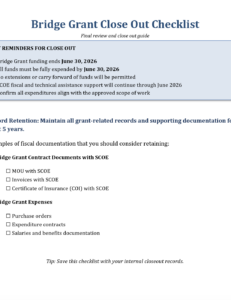
Bridge Grant Close Out Checklist
June 30, 2026
Checklist includes key reminders for grantees as the grant program sunsets, including:
- Bridge Grant funding ends June 30, 2026
- All funds must be fully expended by June 30, 2026
- No extensions or carry forward of funds will be permitted
- SCOE fiscal and technical assistance support will continue through June 2026
- Confirm all expenditures align with the approved scope of work
Bridge Grant Legislative Report
May 1, 2026
The Behavioral Health Bridge Grant Legislative Report is a summary of the funding process, results, and themes from applications.
This report was submitted to the Legislature on May 1, 2026.
For a fully accessible version, please access here.
If you are unable to access Google Drive-hosted documents, please see the Adobe-hosted designed report and accessible version.
Training and Technical Assistance Materials
Website Overview & Documentation Toolkit Training
This webinar featured a walk through of applicable resources from the Capacity Grants website, and a deep dive in the Documentation Toolkit.
CYBHI Fee Schedule Services Crosswalk Toolkit Training
This webinar featured a walk through a Fee Schedule services crosswalk. The purpose of the crosswalk is to support LEAs in understanding school services that may be reimbursable through the Fee Schedule program.
Grant Details
Assembly Bill 121, the education finance omnibus budget trailer bill for 2025-2026, appropriated $20 million to the California Department of Education to allocate to the Sacramento County Office of Education (SCOE) to, in partnership with the Santa Clara County Office of Education (SCCOE), award grants to local educational agencies (LEAs) participating in the first, second, and third cohorts of the Children and Youth Behavioral Health Initiative (CYBHI) Fee Schedule Program.
Priority Funding Areas
The authorizing legislation for this grant opportunity specifies two priorities:
- Primary grant priority: To prevent the disruption of providing school-linked behavioral health services in the 2025–26 school year, including staffing costs for school employees who provide youth mental health services.
- Secondary grant priority: For technical assistance for the continued implementation of the school-linked statewide fee schedule established pursuant to Section 5961.4 of the Welfare and Institutions Code.
Eligible LEAs will be able to apply for one or both funding areas. Grantees may spend no more than 25% of the maximum grant amount for which they are eligible on the secondary priority.
Eligible Entities
Eligibility is limited to LEAs (defined as a school district, charter school, or county office of education) participating in CYBHI Fee Schedule Cohorts 1, 2, or 3.
Applicants may apply as an individual LEA, or as a Lead LEA on behalf of multiple eligible LEAs. Examples: 1) A billing consortium lead LEA may apply on behalf of other eligible LEAs that are members of its billing consortium, 2) A single charter LEA may apply on behalf of other eligible charter LEAs that are part of the same charter network or charter management organization (CMO).
Eligibility Determination
Sacramento County Office of Education (SCOE) reviewed documentation for participating LEAs in Cohorts 1, 2, and 3 (including cohort application data and provider participation agreement submission data). This data informed SCOE’s decision-making around eligible entities for the application invitation. Where no documentation of cohort participation was available, applicants were deemed ineligible and offered an appeals process.
Grant Amounts
Funding award amounts are available at this link.
Following the submission of a complete Letter of Intent (LOI), eligible LEAs were invited to submit a full application. The application invitation includes a maximum grant amount that the applicant may request in their application.
These amounts were determined based on the number of eligible applicants, LEA enrollment, and unduplicated pupil percentage. A funding amount was determined for eligible LEAs as follows: a base amount of $18,500 plus an additional $6,100 for every 1,000 students enrolled (based on the 2024-25 CALPADS data). LEAs also received a 1.15 multiplier if their Unduplicated Pupil Percentage (UPP) was 75% or greater. The maximum amount for any single LEA was $855,000. For applications involving multiple LEAs, the amounts for all included eligible LEAs were added together to determine the application amount.
Examples:
- LEA A: Applied alone and has fewer than 1,000 students enrolled and a UPP of 50%
- $18,500 base amount
- No additional funding for enrollment with fewer than 1,000 students enrolled
- Total amount: $18,500
- LEA B: Applied alone and has more than 14,000 but fewer than 15,000 students enrolled, 79% UPP
- $18,500 base amount
- + $85,400 based on student enrollment (14 x $6,100)
- 1.15 modifier for UPP
- Total amount: $119,485 = ($18,500 + $85,400) x 1.15
- Had LEA B included LEA A in a group (multiple LEAs) LOI submission, the total application amount would be $137,985 = $18,500 (calculated above for LEA A) + $119,485 (calculated above for LEA B).
Final award amounts are subject to change based on the number of applications received.
Grant Period
This is one-time funding. The authorizing legislation specifies the 25-26 school year. In alignment with the legislation, the grant period will be retroactively effective from July 1st, 2025, and will end on June 30th, 2026.
Allowable Use of Funds
Use of funds needs to be in alignment with the legislative priorities. Funding may not be used for capital outlay.
Application Process
Process Overview
Eligible LEAs will be required to complete a two-step process to apply for funding:
- Submit a Letter of Intent (LOI) – opened October 6, 2025; closed on October 31, 2025
- LEAs were invited to submit a LOI to express interest in the grant program. Submission of an LOI was required to be invited to submit a full application.
- Submit a Grant Application – opens November 17, 2025; due December 12, 2025 (5:00 P.M. PST)
- Eligible applicants received an invitation to submit a full application for funding. The invitation specifies the maximum funding amount the applicant may request and a unique link to complete their application. The application requires LEAs to provide a narrative describing how they will use their funding within each priority area specified in the authorizing legislation (see above). Application questions are available in PDF form.
PLEASE NOTE: Incomplete and late Grant Applications will not be considered.
Application Timeline
- 10/06/25: LOI form opens.
- 10/17/25: Deadline for submitting questions via email to bridgegrant@scoe.net
- 10/31/2025: LOIs due by 5:00 P.M. (PST)
- 11/17/2025: Invitations to apply are sent to eligible applicants and application portal opens.
- 11/20/2025: Bridge Grant application information session – 10:00 A.M. to 11:00 A.M. (PST)
- 12/5/2025: Deadline to submit questions for inclusion in the FAQ.
- 12/12/2025: Application deadline for submission 5:00 P.M. (PST)
- January 2026: Funding announcement.
*Timeline is subject to change.
Post-Approval Process
Memorandum of Understanding (MOU)
Should your application be accepted and approved by the Grant Admin Team, your application will be attached to your MOU to SCOE as the scope of work. As such, we recommend that the language you include be both broad enough to accommodate minor changes in implementation and specific enough to describe the work you will be doing and demonstrate alignment with the priority funding areas. Once executed, MOUs will not be modified for changes in the scope of work.
- Examples for priority funding area 1:
- We will use these dollars to fund 3 certified wellness coaches that are hired by our LEA that provide tier 1 school-based behavioral health services at LEA 1, LEA 2, and LEA 3. This aligns with Bridge Funding because…
- We will use the funds to continue our contract with XYZ Services, a local community-based organization, through June 2026. XYZ Services will provide three direct service staff to support schools in our district. This aligns with Bridge Funding because…
- Example for priority funding area 2:
- We will use these dollars to fund one FTE to provide ongoing EHR Training and Billing support to improve fee schedule implementation countywide for LEA 1, LEA 2, and LEA 3. This aligns with Bridge Funding because…
- We will use grant funds to continue supporting our part-time administrative clerk who manages the coordination and billing processes for our Fee Schedule System. This aligns with Bridge Funding because…
- We will use these funds to invest in XYZ software, a secure software, to help us better manage electronic health records. This aligns with Bridge Funding because… Grant Reporting
There will be no required reporting associated with this Grant. The SCOE, the State of California, or their agents shall have the right to review and to copy any records and supporting documents pertaining to the performance of the executed MOU for an audit or for any other purpose related to performance of the executed MOU. The LEA agrees to maintain such records for possible audit for a minimum of five years after final payment, unless a longer period of records retention is stipulated. The LEA also agrees to be financially responsible for any audit exceptions that arise related to its performance under the executed MOU.
Key Links
- Authorizing Legislation – Assembly Bill 121
- Application Links:
- LOI Links:
- Information Session #1 (Nov 20, 2025)
- Information Session #2 (Jan 15, 2026)
- Slide Deck
- Recording (Passcode: FMC&8m!7)
- Q&A Responses
- Bridge Grant Funding Results
Frequently Asked Questions (FAQ)
This section will be updated as questions are received to bridgegrant@scoe.net. Please check back regularly for updates. (Last Updated: 1/16/2026)
- Who is eligible for this grant program?
- This application is open to any local educational agencies (LEAs) participating in the first, second, and third cohorts of the CYBHI Fee Schedule Program throughout California. Cohort participation will be determined as of the LOI deadline, 10/31/2025.
- How do I find my LEA’s CDS Code?
- To find your CDS code, search for your LEA in this CDE School Directory database: https://www.cde.ca.gov/SchoolDirectory/
- Where can I find how much funding my LEA is eligible for?
- Funding amounts will be determined based on the level of interest received through the Letter of Intent process, and as such we do not have an estimate at this time. We encourage all eligible LEAs to complete the LOI if they anticipate having a need for funds that aligns with the legislative intent of this opportunity.
- If a lead LEA is applying on behalf of multiple member LEAs, who should the signatory on the LOI be?
- LEAs may choose to submit an LOI independently or a Lead LEA may submit a single LOI on behalf of multiple member LEAs. Lead LEAs should confer with and gain consent from their member LEAs about this approach. All LEAs included in an LOI must be participants of CYBHI Fee Schedule Cohorts 1, 2, or 3. The LOI only requires a single signature from the Lead LEA’s Superintendent or Designee.
- Only one LOI will be considered per LEA. LEAs should not submit an LOI independently if they have chosen to submit an LOI as a part of a group.
- In the application process, lead LEAs will need to submit documentation of consent (i.e., signed statement; a template will be provided) from each member LEA included in the application.
- If an LEA wants to only apply for the secondary grant priority, how much funding will they have access to?
- The two funding areas of this grant program were determined and prioritized in the legislation. To honor that prioritization, LEAs may only use 25% of their total award towards the secondary priority. Should an LEA only want to use funds toward the secondary priority, they will only be eligible to apply for 25% of the maximum amount included on their invitation to submit a full application.
- Will my LEA receive more funding if we apply independently rather than through our Lead LEA?
- There will be no difference in the amount of funding available for LEAs that choose to submit an LOI independently versus those that apply as part of a group. For applications with multiple LEAs, the full grant amount will be awarded to the lead LEA.
- If we have a multi-county consortium, can the consortium lead in one county send the LOI on behalf of their other county partners?
- Lead LEAs may apply on behalf of member LEAs across and within counties, as long as all members included in the LOI are eligible for the funding opportunity and consenting to this approach. Documentation of consent will be required in the application.
- For a multi-county approach for the primary grant priority, we would need additional justification in the full application stage to ensure that the funds are being used in alignment with the legislative intent.
- Should a dollar number request be included in the LOI?
- No, LEAs should not include a requested dollar amount in their LOI. To view the questions included in the LOI, please see the PDF of the questions here.
- Is a LEA, such as a COE, able to apply for priority 2 of the Bridge Grant if they are not enrolled in Cohorts 1, 2 or 3 but provide technical assistance to LEAs enrolled in one of those cohorts?
- If you are not participating in CYBHI Fee Schedule Cohorts 1, 2 or 3 you cannot apply for the grant. The applicant must be eligible for the funding opportunity.
- Is there a matching fund requirement (in-kind or cash)?
- There will be no matching fund requirements.
- What consent will be required in the application process if we are applying as a group of LEAs?
- The grant application will require upload of explicit consent from member LEAs. That proof of consent will need to explicitly state that they are consenting to being included in a group application for the Bridge Grant, and that they understand all funding is going to the Lead LEA on the application. This consent must include a Superintendent or designee signature. If you are a single-single, please still submit a letter of consent from your superintendent or designee.
- Please see a template here. There is no letterhead requirement for the template.
- What are allowable funding activities?
- Please review the legislative text. Funding may not be used for Capital Outlay. Capital outlay is described as funds used to purchase, improve, or maintain capital equipment, property, or assets of $10,000 or more.
- What is the timeline for this grant program?
- The authorizing legislation specifies the 25-26 school year. In alignment with the legislation, the grant period will end on June 30, 2026. LEAs should plan for an end date of June 30, 2026 and a start date of July 1, 2025.
- If the grant is awarded and it is targeting the 2025-2026 school year, does it need to be for expanding services, or can the funds be used to offset the cost of those services already in place?
- The funds must be used to cover the costs for the 2025-2026 school year. Funding must be spent by June 30, 2026.
- Does the application submitter need to be the same person that submitted the LOI?
- No. Any individual authorized to submit the grant application may submit their LEA’s application.
- Can I open the application to look at the prefilled information without submitting it?
- Yes, you can open the prefilled link as many times as you’d like. However, the form will not save draft responses, so please draft your responses outside of the form in a document. Once you hit submit, you will be unable to edit your submitted responses without contacting the Grant Admin team.
- Is the number included in the invitation to apply inclusive of the UPP modifier?
- Yes.
- Is there a scoring rubric for this grant?
- No. There is no scoring rubric for this grant. The Grant administrators will review applications for eligibility and alignment to the legislative priorities.
- Can we change which priorities we would like to apply to in the application?
- Yes.
- Can grant funds be used for existing expenses?
- This is one-time funding. The funds must be used to cover costs for the 2025-2026 school year. The grant period is July 1, 2025 through June 30, 2026. Funds must be used in alignment with the legislative priorities.
- Am I required to pass through funds to LEAs if I am submitting a group application?
- No.
- Can LEAs that were included in my group LOI now apply independently if our intention is to pass through funding to them?
- You may pass through funds to eligible LEAs in your group application. Eligible LEAs that were included in your group application may also opt to apply independently. If there is a preference for any LEAs included in your invitation to apply separately on their own, please direct them to reach out to bridgegrant@scoe.net for an application link and so we may indicate their maximum funding amount.
- Given the limited amount of funding, purpose of the grant, and the timeline for expenditure, if you are planning to pass through funds to LEAs, we encourage you to do so as quickly as possible and to minimize any indirect costs you are charging on those funds.
- Do we need to use Bridge Grant funds to support only those LEAs included in the application?
- Grant-funded activities should support students in the eligible LEAs listed in your invitation to apply.
- What percentage of funding should be allocated for indirect and administrative costs?
- The maximum indirect rate for this grant program is 10% of direct costs.
- After receiving the award notification, are there additional steps we need to do, other than signing the MOU from InformedK12?
- Yes. Please complete out the Certificate of Insurance and Invoice Submission Form, found within your award notification email.
- Can the watermarked MOU narrative be revised before the official MOU is sent out from InformedK12?
- The watermarked MOU is intended for your internal review only (not for signature) and will not be revised by SCOE. If changes are needed to the final MOU that SCOE will send via InformedK12, please contact us via email at bridgegrant@scoe.net
- When should we expect to receive the MOU from InformedK12?
- We anticipate that your LEA signatory will receive the MOU via email from InformedK12 the last week of January. This timeline is subject to change.
- My watermarked MOU requires a “Commercial General Liability Insurance with limits of no less than $2,000,000 per occurrence and $4,000,000 aggregate” but the COI and Invoice Submission Form shows different numbers. Which is correct?
- The watermarked MOU shows the incorrect amounts. The required coverage amounts are $2 million aggregate and $1 million per occurrence. The correct insurance amount will be reflected in the MOU that your MOU signatory will receive via InformedK12.
- Do we need to complete the MOU in InformedK12 first, before the Certificate of Insurance and Invoice Submission is due?
- No. You are welcome to submit the Certificate of Insurance (COI) and invoice during or after the MOU process. Sacramento COE will need the COI prior to processing your invoice. We encourage you to submit the COI and invoice as soon as possible. Both the COI and invoice must be submitted no later than June 30, 2026.
- For grouped applications, is there a separate MOU for each participating LEA? Do you need a separate COI and Invoice Submission Form for each participating LEA?
- No. Only one MOU is required between the lead applicant of a group application and SCOE. Only the lead applicant will need to submit a COI and invoice for the full award amount.
- What resource code should be used?
- The resource code SCOE will be using is 7810, but it can be any locally defined state-restricted resource code that rolls into 7810.
- Will the invoice be for the entire amount awarded?
- Yes, please invoice for your total award amount.
- Does it matter whether indirect costs go into the Primary Priority or Secondary Priority category?
- Indirect costs should be attributed to the priority that includes the direct costs that indirect is being charged on.